From Sophomore Strategy to $1.1 Million in Scholarships
 Christen Arafeh
What Estella’s College Admissions Journey Reveals About Starting Early, Building Intentionally, and Creating Options
When people hear “over $1 million in scholarship offers,” they usually assume there was some secret formula behind it.
Perfect scores.
An impossible schedule.
A student who never slept.
But after sitting down with Dinah Estella Holland to reflect on her college admissions journey, what stood out most was not perfection.
It was strategy.
It was consistency.
And it was starting early.
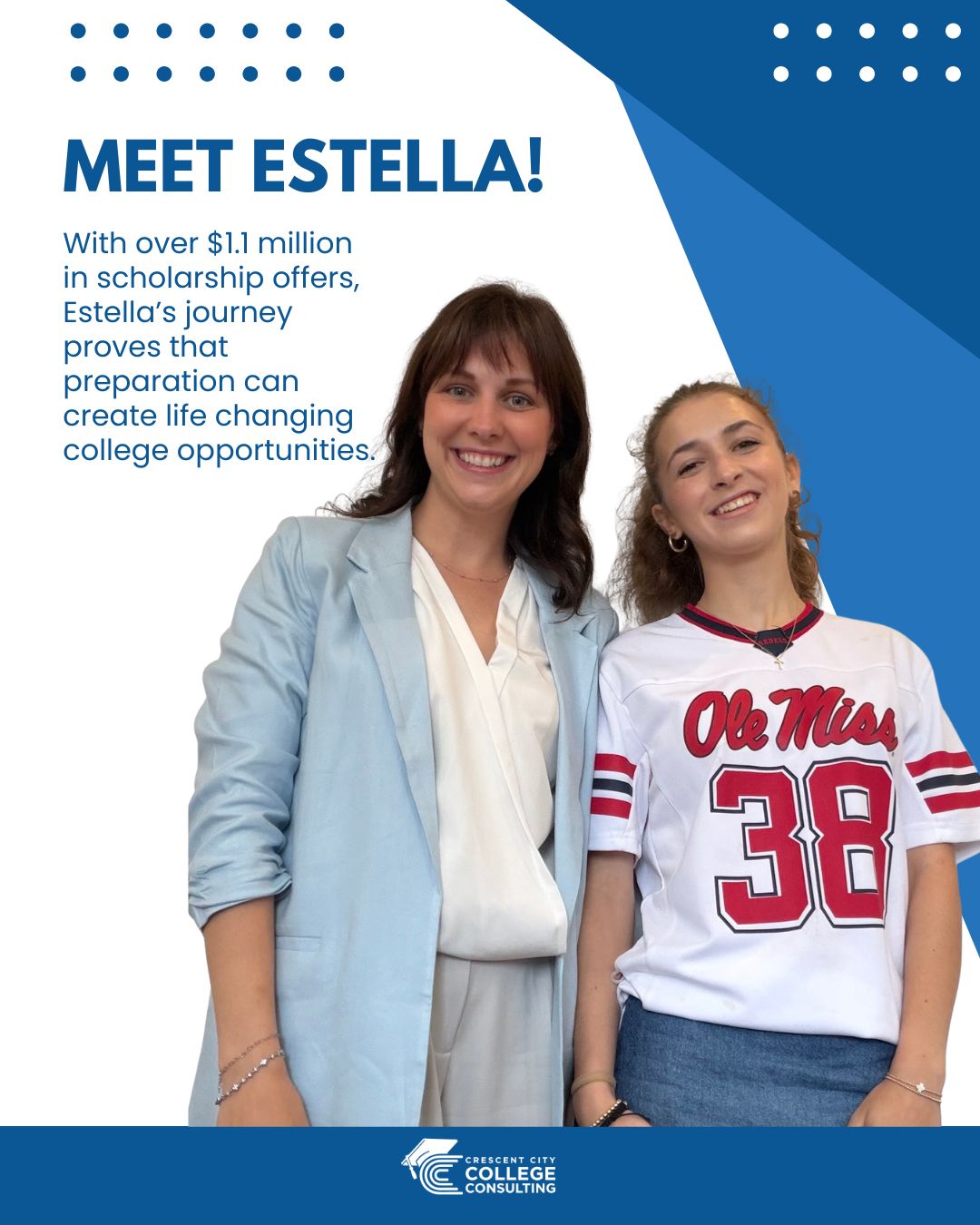
Estella, a senior at Ursuline Academy in New Orleans, earned $1,130,644 in scholarship offers from universities across the country before ultimately committing to University of Mississippi.
Her offers included major scholarships from Tulane University, Sewanee: The University of the South, University of Arkansas, Rochester Institute of Technology, Centre College, Fordham University, and University of Mississippi, where she was selected as a STAMPS Scholarship recipient.
But the most important part of her story is not the number.
It is the process behind it.
Starting Early Changed Everything
One of the biggest themes throughout our interview was how much starting early mattered.
Estella did not wait until senior year to suddenly “get serious” about college admissions. She began building intentionally as early as sophomore year.
Instead of focusing only on grades and test scores, we worked on:
- Building a long-term activity resume
- Finding meaningful leadership opportunities
- Strengthening community involvement
- Using summers intentionally
- Tracking accomplishments over time
- Learning how to tell her story effectively
That foundation became incredibly important later.
By senior year, Estella was not scrambling to figure out who she was or what she had accomplished. She already had years of growth, leadership, and reflection behind her.
What Her Application Profile Looked Like
By the end of high school, Estella had built a highly competitive profile that reflected both academic achievement and authentic involvement.
Her accomplishments included:
- A 35 ACT score
- Leadership positions across multiple organizations
- National recognition in French
- Significant community service involvement
- Competitive sailing experience, including the Rose Bowl Regatta
- Two years as captain of the Ursuline Cross Country team
- Qualification for Quiz Bowl Small Schools Nationals
- Multiple Catholic leadership awards and recognitions
But something she emphasized repeatedly during our interview was this:
None of those things happened overnight.
They were built gradually through intentional decisions made over several years.
The Essay Process Most Students Underestimate
One of the most eye-opening parts of our conversation was discussing just how much writing goes into a competitive admissions and scholarship process.
By the end of application season, Estella had written:
- 1 personal statement
- 15 supplemental college essays
- 27 scholarship essays
That is more than 40 essays total.
When students hear about major scholarship results, they often picture acceptance letters and award amounts. What they do not see are the late nights, constant revisions, rewrites, brainstorming sessions, and emotional energy that go into crafting strong applications.
Estella spoke honestly about the discipline required to continue showing up — even when she was tired, overwhelmed, or uncertain.
And that honesty matters.
Because one of the biggest misconceptions students have is that scholarship winners are somehow naturally confident or effortless.
The reality is usually much less glamorous:
They revise.
They second guess themselves.
They get stressed.
And they keep going anyway.
Scholarships Are Not Just “Luck”
One of the biggest takeaways from Estella’s story is that major scholarship outcomes are rarely random.
There are real strategies behind building a competitive application.
That includes:
- Creating a balanced college list
- Understanding financial fit
- Building a strong activity resume over time
- Applying broadly and strategically
- Preparing thoughtfully for interviews
- Learning how to communicate impact and authenticity
Estella also applied to 23 outside scholarships in addition to institutional awards from colleges.
That level of effort matters.
The students who tend to see the biggest outcomes are often the students willing to continue applying, revising, interviewing, and showing up long after many of their peers have mentally checked out.
The Interview and Scholarship Process
During our conversation, Estella reflected on interviews connected to programs like Posse and major scholarship competitions.
One thing she shared was that many interviewers were not necessarily looking for “perfect” answers.
They were looking for:
- Authenticity
- Self-awareness
- Leadership
- Communication skills
- Evidence of initiative
That is important for students to understand.
Scholarship committees are not just evaluating grades. They are evaluating potential, character, and how students might contribute to a campus community.
Why She Chose Ole Miss
After receiving offers from universities across the country, Estella ultimately committed to University of Mississippi.
And honestly, that decision reflects something I care deeply about when working with families:
The “best” school is not always the one with the biggest name or highest sticker price.
The best choice is the school that aligns with:
- A student’s goals
- Their personality
- Their academic interests
- And their financial future
Scholarship strategy is not just about winning money.
It is about creating options.
It is about reducing debt.
It is about helping students step into adulthood with freedom and flexibility.
Estella’s Advice for Younger Students
At the end of our interview, I asked Estella what advice she would give younger students beginning this process.
Her answers were simple — but incredibly important
Start earlier than you think.
The earlier students begin building intentionally, the more opportunities they create for themselves later.
Do more community service.
Not because it “looks good,” but because meaningful involvement helps students grow and better understand the world around them.
Write everything down.
Tracking activities, awards, leadership, and experiences throughout high school makes applications and essays significantly easier later.
Use your summers wisely.
Summer experiences often become some of the most impactful and differentiating parts of a student’s application.
Final Thoughts
Watching students like Estella succeed is exactly why I started Crescent City College Consulting.
Her story is not about perfection.
It is about what can happen when a student starts early, stays intentional, and consistently builds over time.
And if there is one thing I hope families take away from her journey, it is this:
Big scholarship outcomes rarely happen by accident.
They are usually built slowly, strategically, and one decision at a time.
Want Results Like This?
At Crescent City College Consulting, we help students build a plan early — so they can maximize opportunities, stand out in admissions, and earn significant scholarship offers.
📩 Schedule a consultation to start your student’s plan.
Categories: : case study